Blog: Spotlight on Performance Assessment
.png "Spotlight on Performance Assessment Blog Banner")
The Medical Council’s Performance Assessment process aims to determine whether a doctor has, and applies, the knowledge and skill that can reasonably be expected of them given the kind of medicine they are practising. Doctors are generally referred to Performance Assessment on foot of a complaint if the Medical Council believe that it will help to address the areas of concern that have been identified. It is a proportionate, developmental regulatory intervention for doctors that may be experiencing performance related concerns.
Unsatisfactory performance usually relates to a lack of knowledge, skill or experience, alone or in combination. Additionally, system and personal factors may impact on performance. An assessment of a practitioner’s performance identifies their strengths, areas for development, and opportunities for improving or remediating their practice. It is worth noting that performance assessment procedures and activities are not an investigation of the complaint which led to the referral.
After the assessment has been completed, the doctor will be required to address any areas for development deemed necessary to maintain and apply their knowledge and skill to a reasonable standard. The assessment therefore benefits both the doctor concerned and their patients.
What is involved in a Performance Assessment
Performance Assessment Activities
The assessment may look at the totality of a doctor’s practice, or it may take a more focused look at specific areas of practice.
The assessment may include some or all of the following activities:
- Review of information provided by the doctor
- Occupational health assessment
- Multisource feedback survey of the doctors' patients/ colleagues
- Interview of the doctor about his or her knowledge and skill
- Interview of any relevant third parties
- Inspection of the workplace (usually two days on-site)
- Review of the doctor’s clinical records
- Direct observation of the doctor practising medicine
- A case-based interview of the doctor
- An examination of knowledge and skill
Performance Assessment team
Each doctor is assigned a Case Officer on referral who will explain the activities that have been directed and support the doctor throughout the process. The Medical Council have a panel of qualified, trained assessors who conduct some of the activities. Generally, the Assessment team will be comprised of two medical professionals from the same discipline as the doctor, and one lay person.
Confidentiality
All information in connection with the various performance assessment activities is deemed confidential. Under Section 95 of the Act, such information is carefully safeguarded by persons involved in or assisting with the process.
Length of Performance Assessment
As each case is unique, the time from referral to completion of a Performance Assessment is variable. While it is possible for some assessments to be completed in a number of months, it is not unusual for a full scope assessment encompassing all or most of the activities to take a year or more. Factors that affect the time period include the type and number of activities directed, the availability of suitable assessors, and the engagement of the doctor.
Supporting the doctor
We are aware that some doctors may perceive a performance assessment as a daunting process, however, we endeavour to make it as supportive as possible and find that the best outcomes are achieved when doctors engage positively.
For example, if a practice visit takes place as part of the performance assessment, we recommend that the doctor views this as an educational visit from peers, at the end of which, they may receive some helpful advice on how to improve their practice.
Notwithstanding this, we understand that the assessment process may impact on a doctor, both on a professional and personal level. It is normal for people, wherever they work, to feel worried when they receive a complaint or a concern about their professional ability. We always encourage doctors involved in our processes to seek support from a trusted colleague, this might be another doctor who provides a collegial relationship, a work colleague, a friend from medical school or one of the support services available to doctors.
Outcome of the Performance Assessment
Typically, the outcome of a performance assessment is not as daunting as some practitioners might think. Following the assessment process, if areas for improvement have been identified, the doctor develops an action plan which details how they will address those aspects of practice. Areas for development can include continuing medical education and attending courses on, for example, record keeping, prescribing or communication skills. Doctors might also seek to address aspects of their practice requiring improvement by engaging in peer-to-peer discussion and quality improvement initiatives. Self-reflection is also encouraged for the doctor to consider the actions that resulted in referral to performance assessment.
To date, the feedback received from doctors about their experience of performance assessment has been that they have found the process constructive. Some doctors have commented that they were anxious and worried when they were originally referred but were relieved to discover that Performance Assessment is developmental by nature and non-punitive. They have commented that when an assessment team attended their practice, they were made to feel at ease. Doctors have also commented that the reflective practice has been valuable and has helped them to understand the improvements needed in their practise.
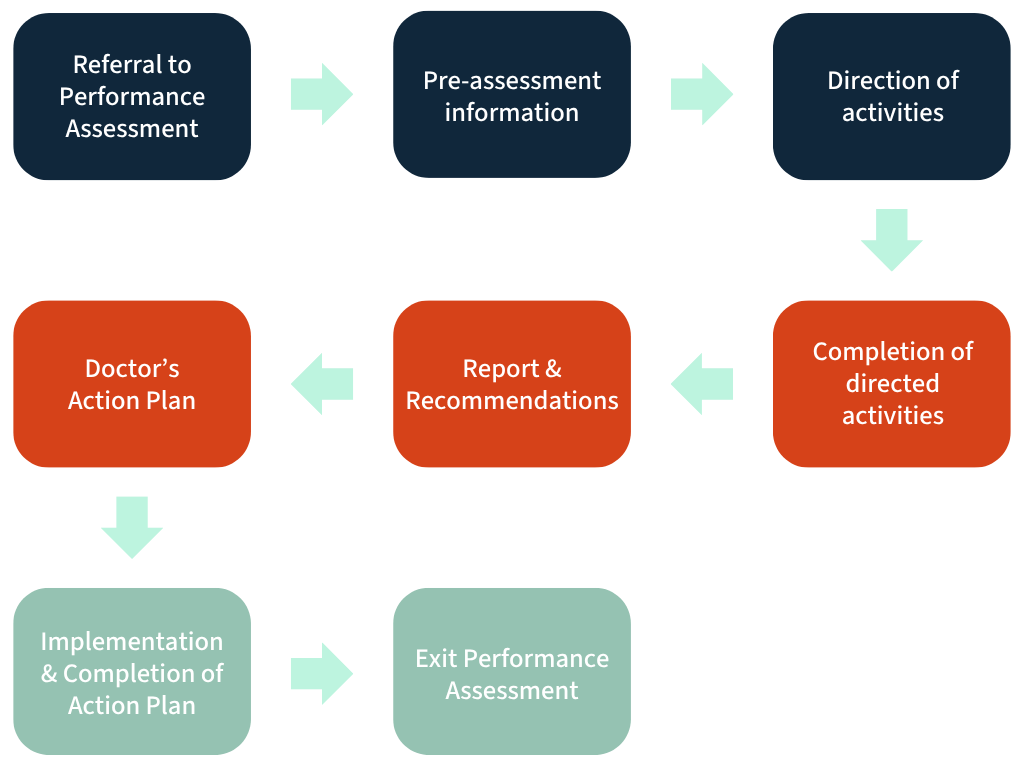
Typical Performance Assessment